

During the 1870s, urban firefighting underwent a massive shift as municipal public departments rapidly replaced old, private insurance-run brigades. This decade was defined by the modernization of equipment, standardized uniforms, and the professionalization of firefighters under structured public funding.
The 1870s marked a transition away from exhausting hand-pumped manual engines toward high-powered mechanics:
- Steam Fire Engines: Horse-drawn steam-pumped engines became the industry standard. They could pump roughly 300 gallons of water per minute, drastically outperforming manual labour.
- Telegraphs and Alarms: Cities began installing street fire alarm boxes. These wired directly into centraliaed "superintendent stations," allowing brigades to dispatch to emergencies much faster.
26th July 1876
At about 01:15 hrs on 26th July 1876, 2 local policemen, PC Newbury and PC Christopher while doing their rounds of the town, thought they could smell burning and went towards South Street. They saw flames coming from Mr J S Farleigh’s premises and shouted fire while knocking at Mr Farleigh’s door. Mr Farleigh was the current Mayor of Torrington. The premises – a 5 storey building complete with cellar, business premises and 3 upper floors with sitting and bedrooms were filled with smokes. The residents escaped with just their night clothes. Mr Farleigh asked PC Newbury to help him go into the office within the shop to retrieve the books. As they could not open the shop door, PC Newbury broke the glass in the door but the flames intensified and Mr Farleigh had to be prevented from entering the shop.
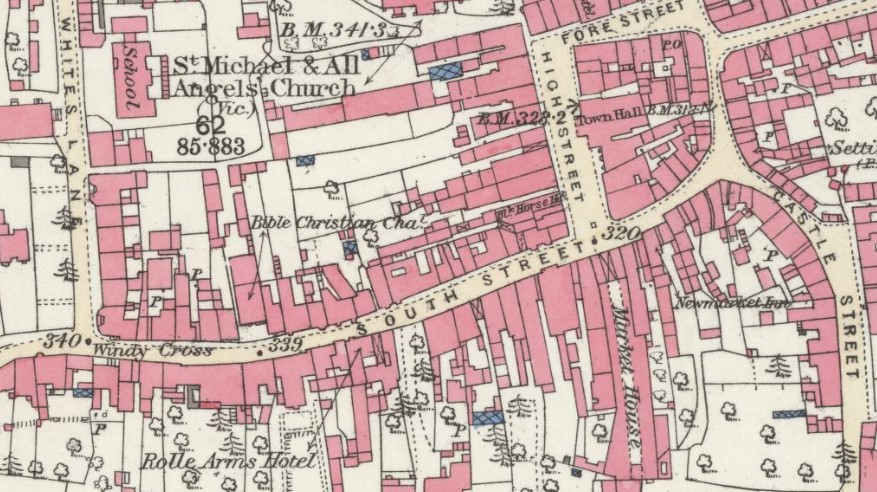
Ordnance Survey Map 1886 showing South Street
The alarm was raised. PC Christopher was dispatched to alert both the Volunteer Fire Brigade and his Supt. Rousham. A volunteer fire force was soon assembled and the fire alarm was raised by someone running around the town shouting fire, the buglar of the Fire Brigade, Thomas Werry, blowing his bugle around the town and someone ringing the church bells. The large fire engine was quickly on the scene but unwinding the water hose and attaching it to a nearby standpipe took some time. Meanwhile the smaller fire engine was soon taken to the rear of Mr Farleigh’s premises to a home and business owned by Mr Charles Doe and proceeded to try and limit the fire from spreading.
In a very short time period, the whole of Mr Farleigh’s house and premises were gutted. Everything was destroyed -stock, furniture and personal possessions. The stock included general groceries and provisions in addition to the wines and spirits. Mr Farleigh was the local agent for Messers Gilbey and Sons (a long standing company which is now owned by Diageo). The alcohol was stored in the cellar and when affected by the heat of the flames caused several explosions.
The premises adjoining Mr Farleigh’s shops were affected. The premises behind owned by Mr Charles Doe caught fire and, thanks to “the energetic action of the firemen” and others, only the roof was consumed.
The fire raged for over 4 hours and by 06:00 hrs was ‘subdued’, but the hoses continued to dampen the fire.
Mr T.W Haverfield’s establishment on the higher side of the street but adjoining Mr Farleigh’s shop also caught fire. The large fire engine hose was sent to work close to a deep well in Market Place. Mr Haverfield and another business owner, Mr Lee, managed to rescue their stock and furniture. Mr Lee moved all of his stock and furniture to Market Place while the firemen ran a hose through his shop and out the other side, up onto the roof and through the drawing room window of Mr Doe’s premises which managed to limit damage in Mr Doe’s house. Sparks from the fire were “carried in volumes” and set alight to 2-3 homes in Castle Street as well as some thatched cottages in Caddy well which is ¼ mile distant from South Street.
While fighting the fires, Mr W. Colwill fell off a roof and had to be carried home. Mr. Robert Dennis, veterinary surgeon, fell and sustained a dislocated shoulder. Mr William Heywood sustained a severe head cut due to a falling roof slate. Supt. Rousham suffered a cut to his leg. The “medical gentlemen of the town” attended the casualties.
Mr Farleigh’s shop and home suffered a fire 16 months previously and was now only partially insured. Damage was estimated to be £3,000-£4,000. Cause of the fire was not established.
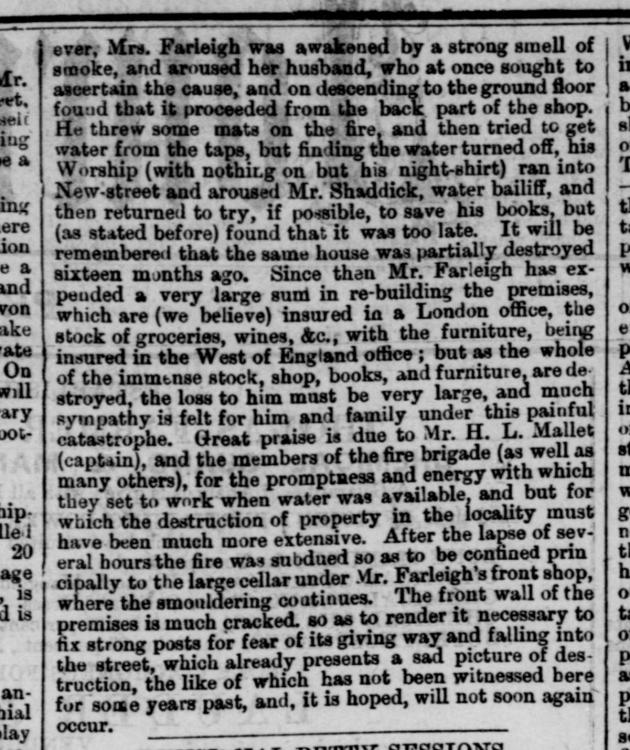
In the North Devon Journal, 27 July 1876, it states that “Mrs Farleigh was awakened by a strong smell of smoke, …”
Major Macartney wrote to the Mayor and Town Council of the Borough of Torrington on August 2nd, 1876
“Gentlemen, As our town was visited by a most calamitous fire on the premises of Mr J S Farleigh, situated in the South-street, on Wednesday morning last, this being, I believe, the third fire that has taken place on the same premises within a period of two years, whether by accident, carelessness, or design, has not as yet been found out, so far as I am aware. But no matter how the fire originated, the burning showed plainly enough that a considerable portion of the materials stored there were of a most inflammable nature. I therefore, as a ratepayer and property owner in the town, consider it my duty to call your attention to the amount of inflammable oils stored in several parts of the town. If the premises wherein these oils are stored were to catch fire, I am very much afraid we should have to deplore not only the loss of property but of very many lives. I believe there is an Act of Parliament against the storing of more than a certain amount of inflammable oil in one place; and I know that in several towns there are bye-laws which compel even cabinet-makers to store their varnishes in an isolated building. I therefore trust you will consider it necessary to direct that all inflammable oils beyond a certain quantity must be stored in a suitable building isolated from any dwelling house, so as to minimise, as much as possible, the effect of an explosion from fire, and cause all licensed for the sale of inflammable oils to be periodically inspected. I would further suggest the desirability of having a fire escape provided as soon as possible. Although no lives were lost at the last fire, and no fire-escape needed, one can never tell at what moment it may be wanted. I presume it is not necessary for me to call your attention to the old adage of locking the stable door, &c, &c. I remain, Gentlemen, your obedient Servant, A S Macartney, Major R.A.”
Maybe Major Macartney referred to The Petroleum Acts 1862, 1868 and 1871 to 1881 required a licence from a local authority to store or sell petroleum. Such licences could have conditions attached such as specifying the mode of storage, etc. Petroleum was not to be stored within specified distances of houses or places where goods were stored. Containers for petroleum were to be labeled with appropriate warning notices.
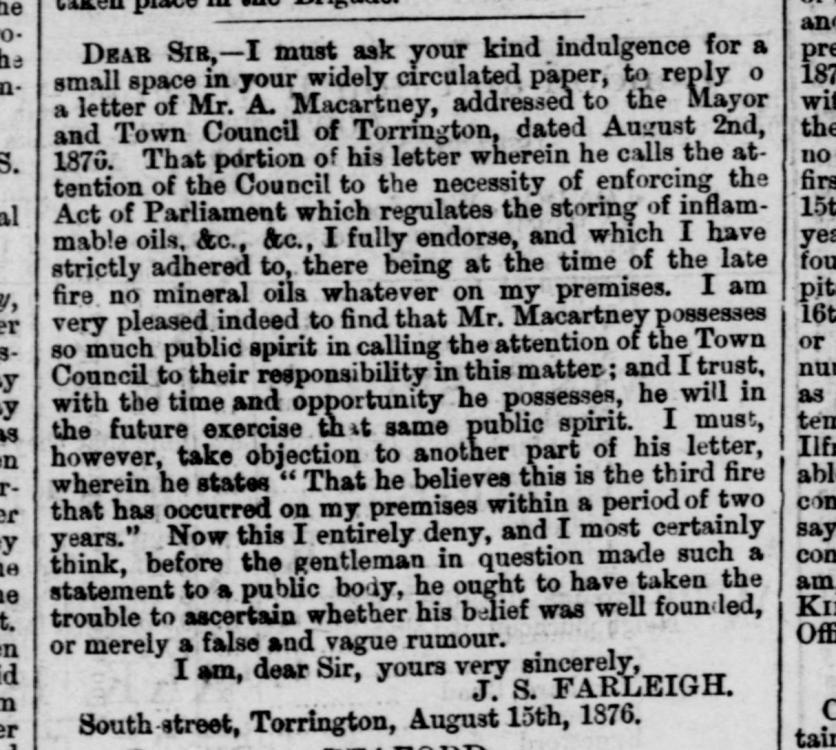
The Mayor submitted a response in the North Devon Journal dated 17 August 1876.
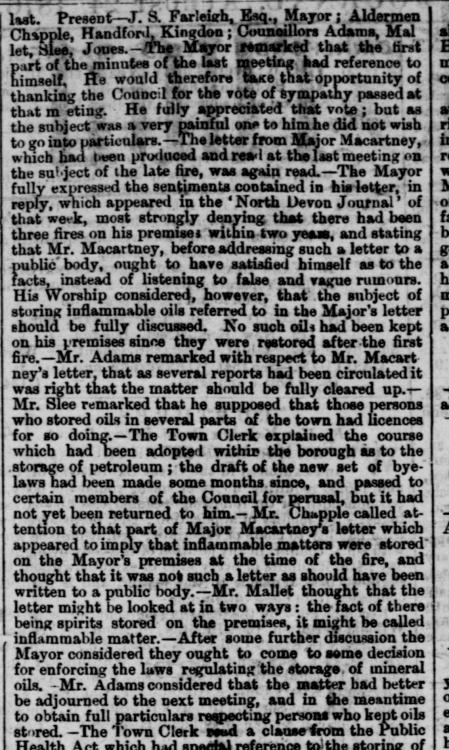
Later in August, it is reported that an adjourned quarterly meeting of the Council was held at the Town Hall. Present were J S Farleigh, Esq, Mayor; Alderman Chapple, Handford, Kingdon; Councillors Adams, Mallet, Slee, Jones. The Mayor remarked that the first part of the minutes of the last meeting had reference to himself. He would take that opportunity of thanking the Council for the vote of sympathy passed but as the subject was a very painful one to him he did not wish to go into particulars but stated that “Mr Macartney, before addressing such a letter to a public body, ought to have satisfied himself as to the facts, instead of listening to false and vague rumours.” No such oils had been kept on his premises since they were restored after the first fire.
At the same meeting, the Town Clerk produced a letter complaining of the stench from the rubbish on this site of the late fire on Mr Farleigh’s premises – “South-street, Great Torrington, 14th August 1876 – Sir, We, the undersigned, being householders in the borough of Great Torrington, and residents in South-street, in close proximity to the scene of the late fire on the premises of Mr J S Farleigh, desire to call your attention to the unremoved rubbish, containing decomposing matter, still lying on the said premises. The stench arising therefrom is at times almost unbearable, and in our opinion is highly injurious to the public health. Nearly three weeks having now expired since the date of the fire, we think it is high time, considering the heat of the weather, that something should be done. We have the honour to be, Sir, your obedient servants, (Signed) T W Haverfield, A S Macartney, Charles Doe, John Hagley, John Lake, Albert Chapman, C H Davey.”
In his obituary, it was announced that Mr Farleigh had carried on ‘an extensive wholesale and retail grocery and provision business in Torrington for thirty-five years,’