
Bideford, Westward Ho! and Appledore Railway
The beginnings
The Victorian tourist industry kickstarted the middle classes taking seaside holidays, and following the success of Charles Kingsley's book, Westward Ho! and visitors coming to Bideford and Appledore, the Northam Burrows Hotel & Villa Company developed a new seaside town, Westward Ho!
The project was mooted in 1860 and gained traction with the Bideford, Appledore, and Westward Ho! Railway Act 1866; however, after the full ‘first sod cutting ceremony’ the contractors went bust. This article from 1871 identifies Edward Humphrey, Esq. as the contractor:
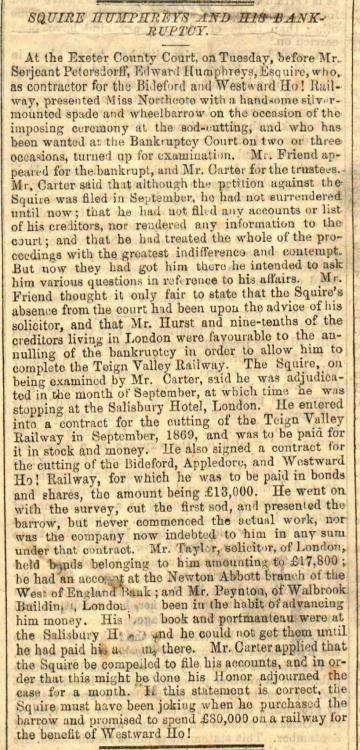
Another Act came into fruition – Bideford, Westward Ho! and Appledore Railway Act 1896 - petitioned to Parliament by George Mill, Frederick Molesworth and George Taylor, and which provided consent for the construction of seven miles of railway. Work was to be constructed within five years.
The Bideford, Westward Ho! and Appledore Railway (BWH&AR) was unusual in that, although it was a standard gauge line and part of the British railway network, it was not joined to it. The London and South Western Railway used to arrive at a station at Bideford, East-the-Water, and BWH&AR ran from the other side of the bridge.The BWH&AR was the only railway company in the British Isles to have an exclamation mark in its title.
The North Devon Journal, 29 September 1898, reported that 'Sleepers for the Bideford, Westward Ho! and Appledore Railway were last week discharged at Bideford from the Lanoy, of West Hartlepool." The same newspaper reported on 26 July 1900; "The curiosity of many residents of Exeter has been roused by the presence of some foreign-looking rolling stock on the London and South Western Railway Company's line near Queen-street goods yard. The carriages in question have recently been built for the new Bideford, Westward Ho and Appledore Railway Company, and they are constructed on the latest American system."
The line opened between 1901 and 1908. The Western Times; Exeter, Friday, April 26, 1901, reported:
“A large crowd assembled on the Strand at Bideford, Wednesday, to witness the starting of the private train on the new railway which has been constructed from Bideford to Westward Ho! It was a glorious day and close on 100 accepted the invitation of the local superintendent to participate in the trip. The construction of the line is all but complete and it is hoped that the formal opening will take place early next month. It is about three years since its construction was commenced by Mr Chas Chadwell, a well-known tramway contractor. After the skeleton of the line had been finished it was allowed to stay in that unfinished condition for some months before the whole concern was bought up by the British Electrical Traction Company about 18 months since. The Company are owners of 20 to 30 different lines similar to this one, and the chief financier of the whole is Mr Pierpont Morgan, the well-known American millionaire.”
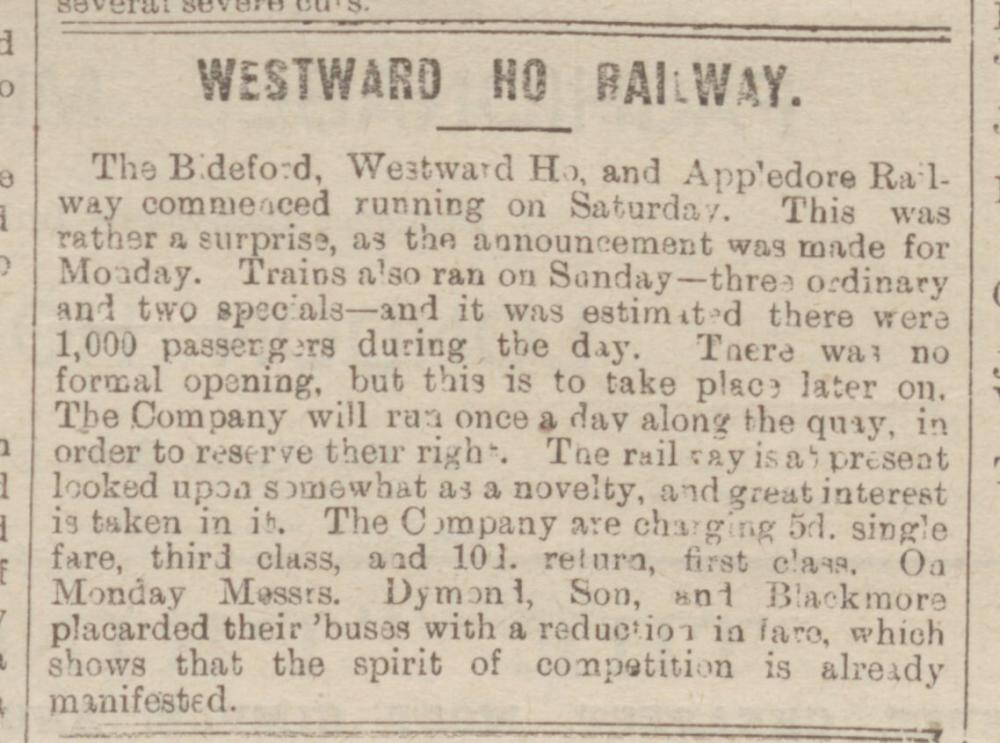
NDJ 23.5.1901
Almost immediately the Railway proved successful.
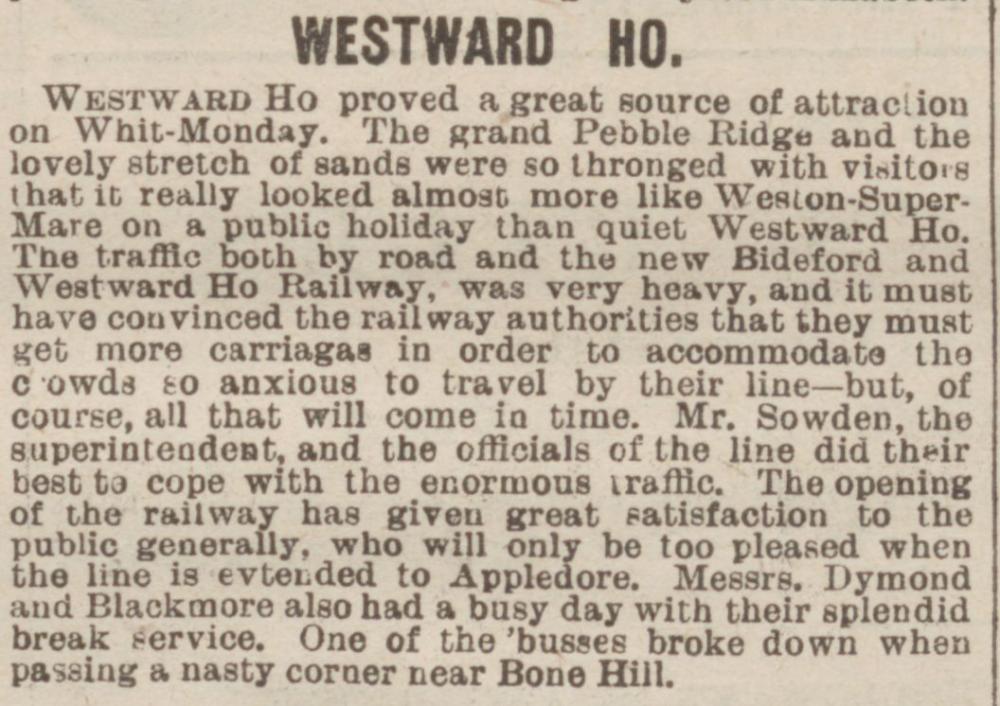
NDJ 30.5.1901
The engines
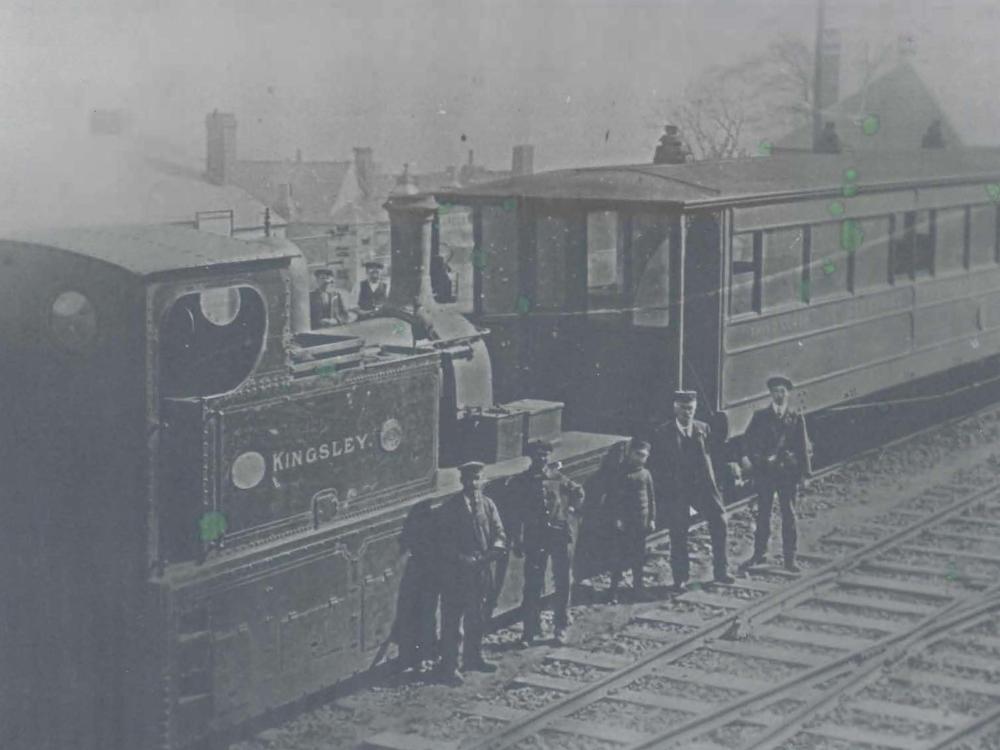
The three engines – Torridge, Kingsley and Grenville – were built by Hunslet Engine Co. Ltd and each weighed 27 tons in working order. Five hundred gallons of water and 18cwt of coal could be carried. There was no turntable and the workaround was for one of the engines, Torridge, to be on the track facing Bideford, and the other two facing Westward Ho!
The signalling was installed by Saxby & Farmer who, from the 1860s to 1880s, were the dominant force in railway signalling equipment manufacture. They were the major contractor responsible for building signal boxes on behalf of railways.
The carriages and coaches
Built by Bristol Carriage & Wagon Works, there were two 3rd class carriages at 66 feet long and 4 coaches of 48 feet long. One carriage was used as a third brake. Bristol Carriage & Wagon Works also built carriages for the Ffestiniog Railway as well as the Lynton and Barnstaple Railway.

Lloyds List December 1877
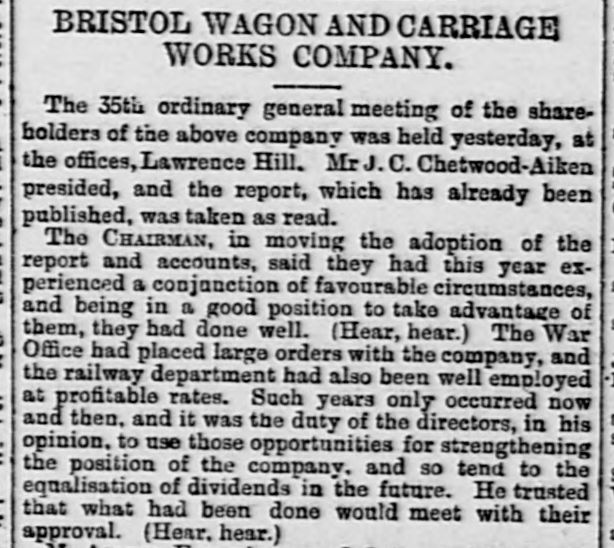
Western Daily Press 19 June 1900
American in style, the carriages were entered at either end by an open metal fence platform, and steps were used at the Bideford Quay terminus and those halts that had no platform. The roofs in the first class carriages were covered in a pale green Lincrusta thick embossed wallpaper. A 1949 advert for Lincrusta states that it is ‘A perfect imitation of Oak Panelling suitable for Hall, Staircase, Dining Room, Offices, etc. Stocked in Buff, requires scumble and varnishing after fixing.’ Lighting was by acetylene gas, seats had ‘American leather’, each coach had a clock and interiors were of polished oak with teak mouldings. Each coach could carry approximately 60 people.
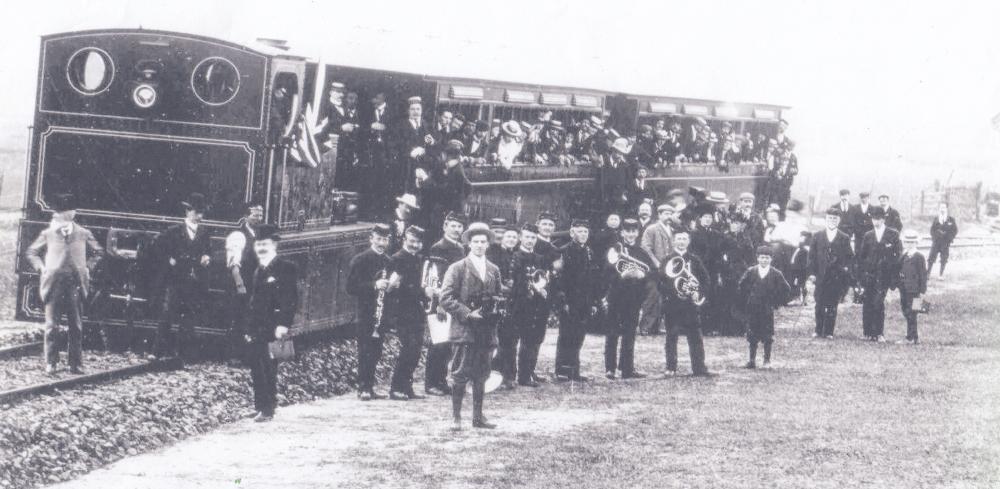
Opening Day celebrations held 24 April 1901
Additionally, there were 6 open wagons, 4 covered wagons and a brake van.
The route
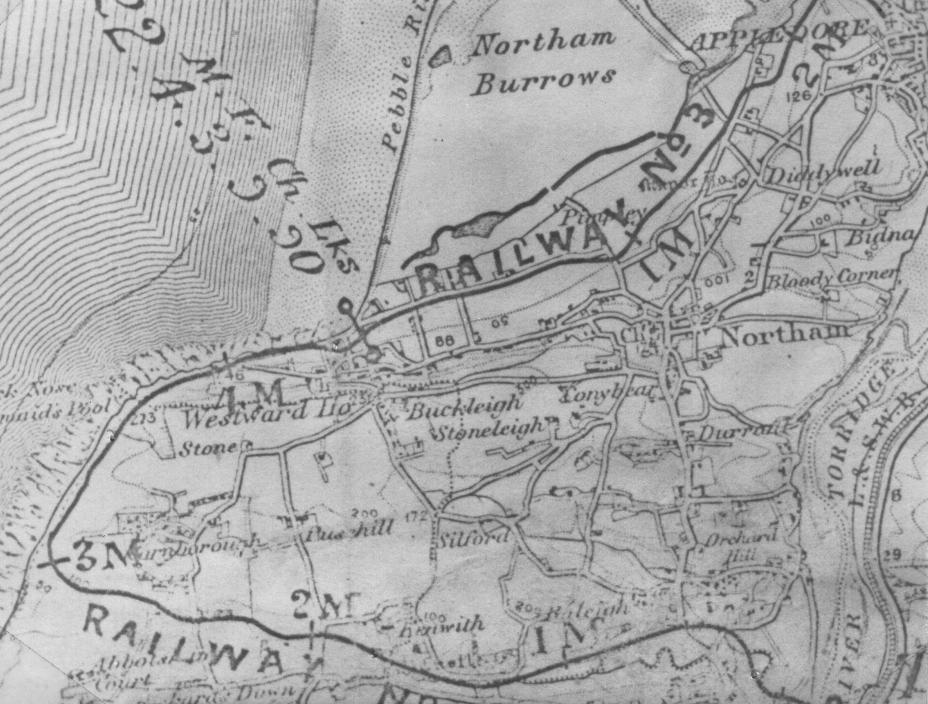
Route of railway
Prior to the extension of the line to Appledore in 1908, Northam was the terminus of the line with the station a little way from the village. It was used by golfers going to and from the Royal North Devon Golf Club. On the down side of the line was a 180ft platform and a shelter, and there was a goods yard. It was reduced to a single line without sidings or signalling when the line was extended. The line crossed Pimpley Road – there were no gates – before reaching the Richmond Road request halt.
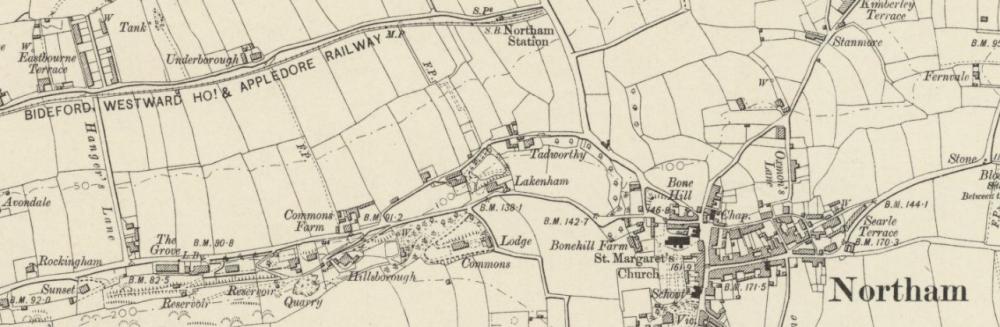
1903 Ordnance Survey Map showing Northam Station
In 1906, The Bideford Westward Ho! and Appledore Railway Company sought funding to extend the Railway from Northam Road to Appledore at an estimated cost of £10,000.
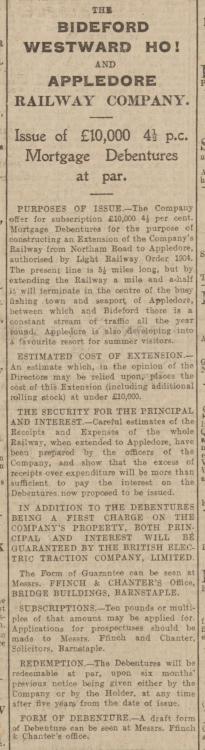
Exeter and Plymouth Gazette 16 November 1906
A description of the extension was issued in The Devon and Exeter Gazette, April 21, 1908;
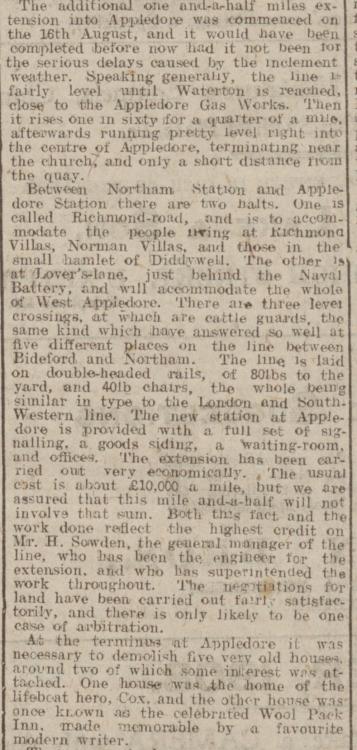
“The scenery to be commanded while on the line is very charming. When near the Battery, for instance, the Barnstaple and Bideford Bar can be seen, with the waters of the bay dashing over it. In clear weather, Lundy Island stands out boldly and Clovelly is visible. The line will be of great value to Appledorians.”
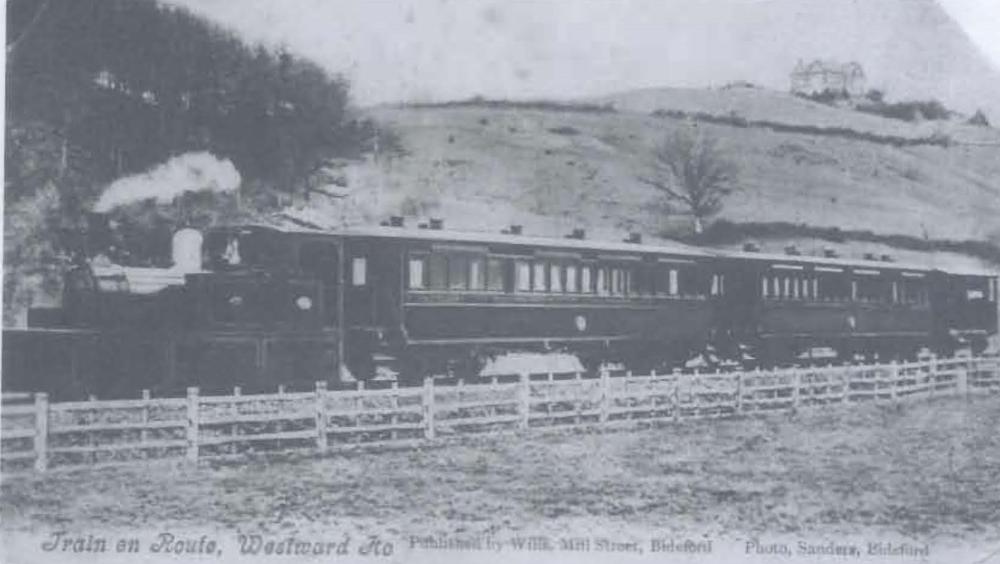
The Appledore extension was open for public traffic on May 1st 1908. Among those taking part in the first trip were Mr W G Bond, Capt Molesworth, H Sowden, Messrs J Fulford, JP, CC, W Ashplant, J B Penhorwood, Capt A McNeill Martin, R G Court, J Harris, A B Cook, P K Harris, J R Mead, J T Slader, J G Pickard, W T Charlewood, W J Barnes, N Richards, W G Champion, H R Moody, John Carter, Rev Scholey, Dr Valentine, P Fulford, F W Purchase, J N Couldridge, W W Perkins, W H Puddicombe, H C Whitehead, G H Corke, H Ascott, JP, J Frith, Lieut Newcombe, RN, W J Lard, S Bale, A Lee, F Lee, F Ellis, A S Gerrard, George Boyle, R M Snow, E Cook, E Lemon, W Cole, C E R Chanter, R B MacDermott, Capt Randall, E Waterfield, J Elliott, A J Saunders, Jno Elliott, R Butler, Rev Muller, H Bale, etc. and Mrs Chanter, Mrs H R Moody, Mrs J H Cocks, Mrs F Lee, Mrs Carter, Mrs Valentine, Mrs Scholey, Mrs A B Cook, Mrs Meade, Misses Meade, Mrs P K Harris, Mrrs Couldridge, Mrs Sowden, Mrs W W Perkins, Mrs W H Puddicombe, Mrs Slader, Mrs Cole, Mrs Corke, Mrs Frith, Mrs Newcombe, Mrs Land, Mrs Bale, Mrs A Lee, Mrs G Boyle, Mrs Snow, Mrs Randall, Mrs Waterfield, Mrs L Shute, Miss Whitefield, Miss Bishop, Miss J L Sowden, Miss Short and others. Mr Harris was the driver of the train and Mr G Camp, guard.
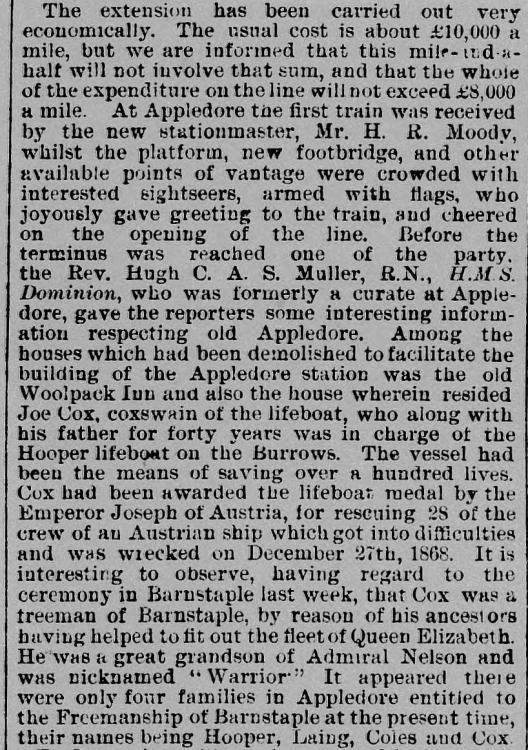
North Devon Herald 30 April 1908
The benefits of having a terminus at Appledore were quickly identified.
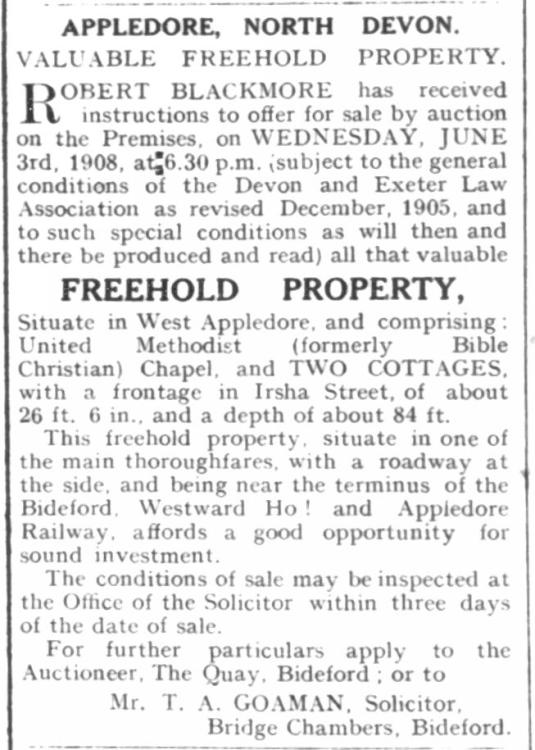
Bideford and North Devon Weekly Gazette, May 26, 1908
Halts
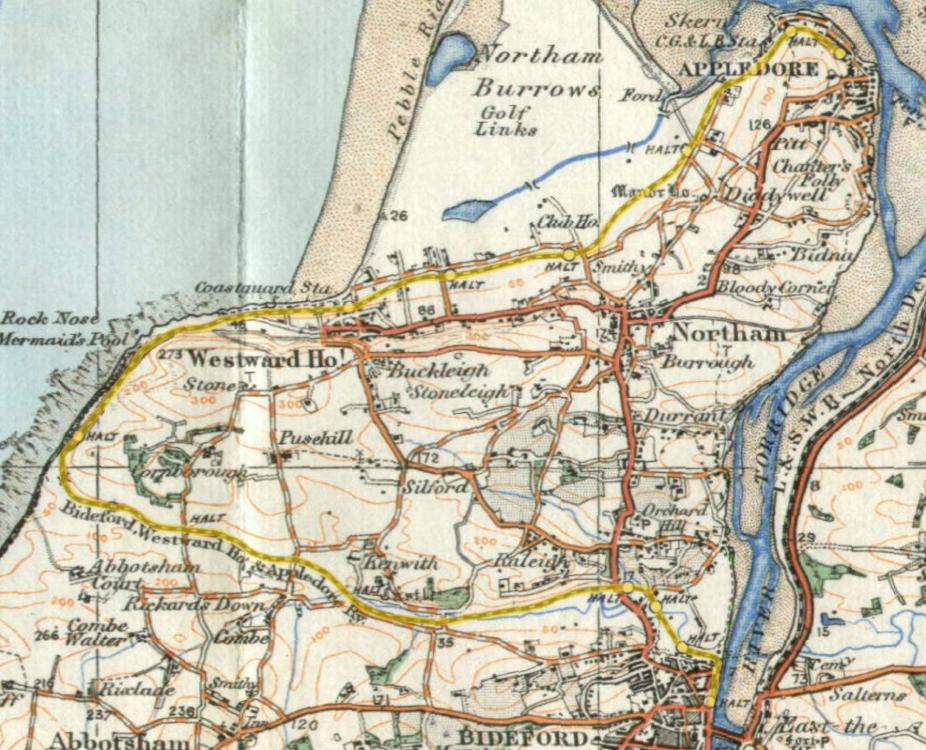
The line was seven miles in length when fully opened and the stops and halts were:
Bideford Quay – there was no platform and passengers had to use steps to reach the ground. There was a manager’s office, a booking office, and a waiting room.
Strand Road – a signal hut
Bideford Yard - a passing loop
The Lane (Chanter’s Lane)
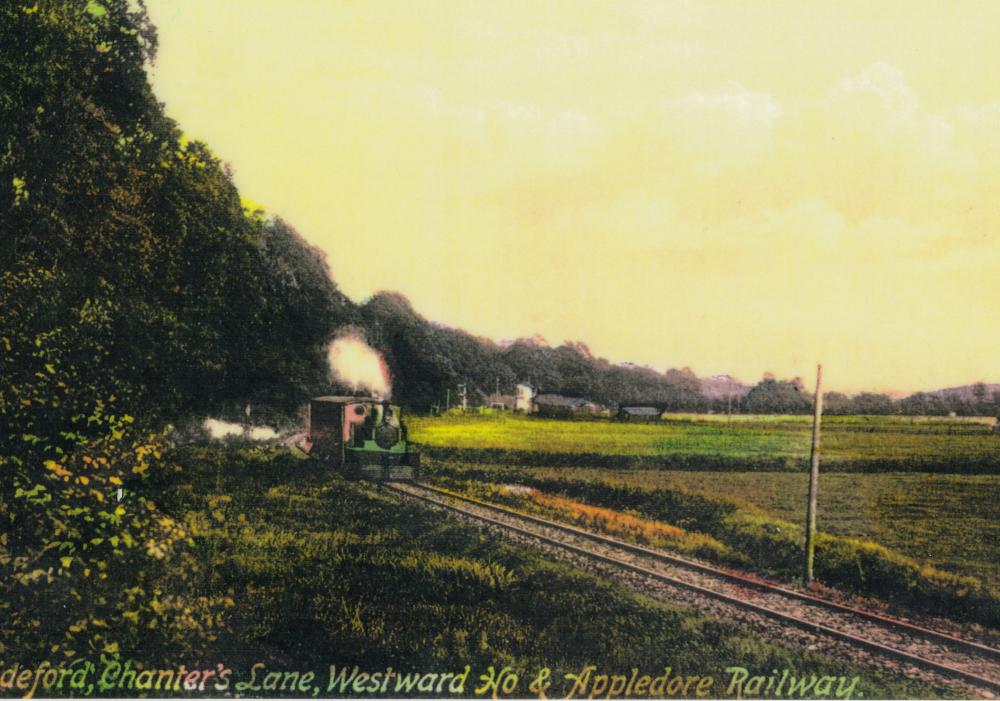
Causeway
Kenwith Castle
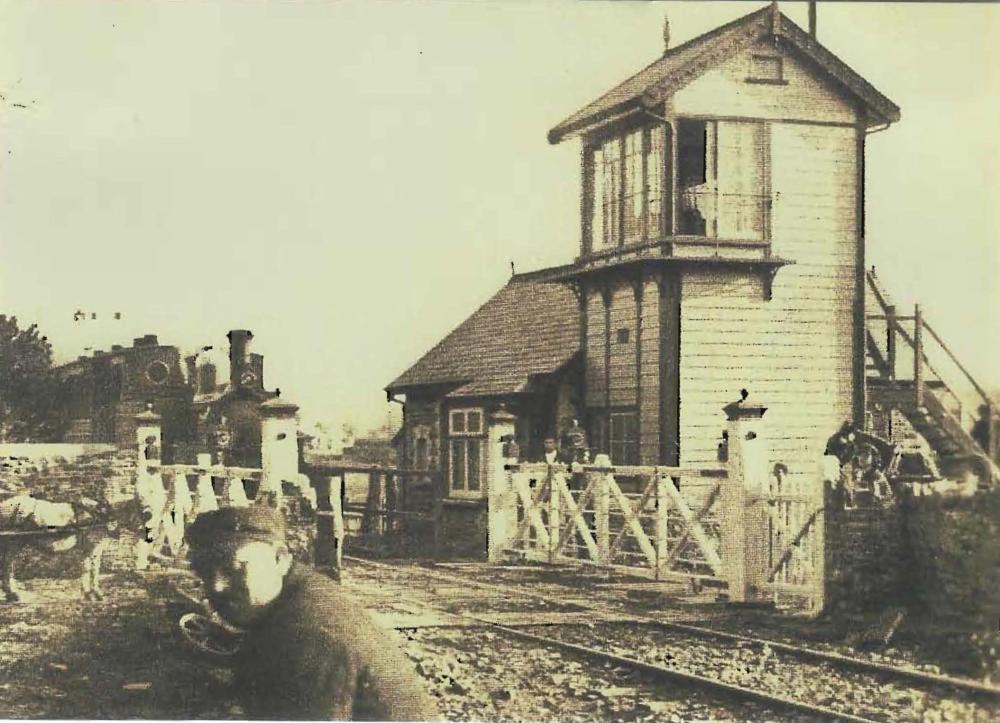
Abbotsham Road Station (previously Mudcott) – there was a passing loop, two wooden platforms, and a combined ticket office and signal box hut.
Cornborough Cliffs
Westward Ho! – this was the busiest station with two platforms, a passing loop, ticket office, signal box, waiting room, refreshment room, bookstall, level crossing gates and a concert hall.
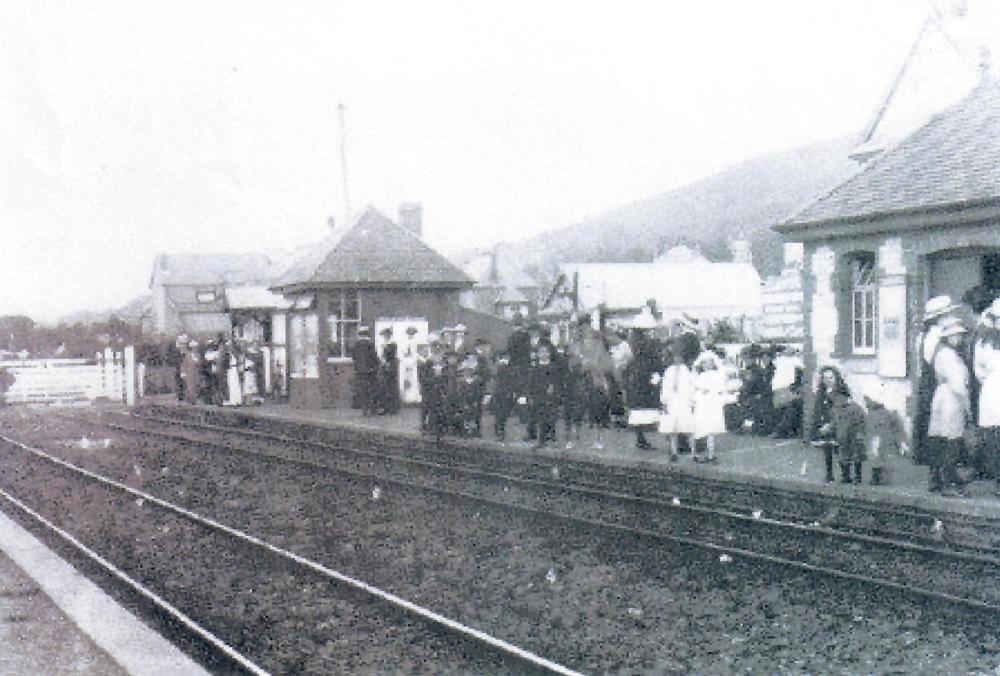
Beach Road
Northam Station
Richmond Road
Lovers’ Lane
Appledore Station – had its own station master, Mr Harold Moody, a run-round loop, one platform, a ticket office, signal box hut, small engine shed, water tower, footbridge, and a fuel store siding. This was the only station on the line to boast a footbridge from Irsha Street to nearby allotment gardens.
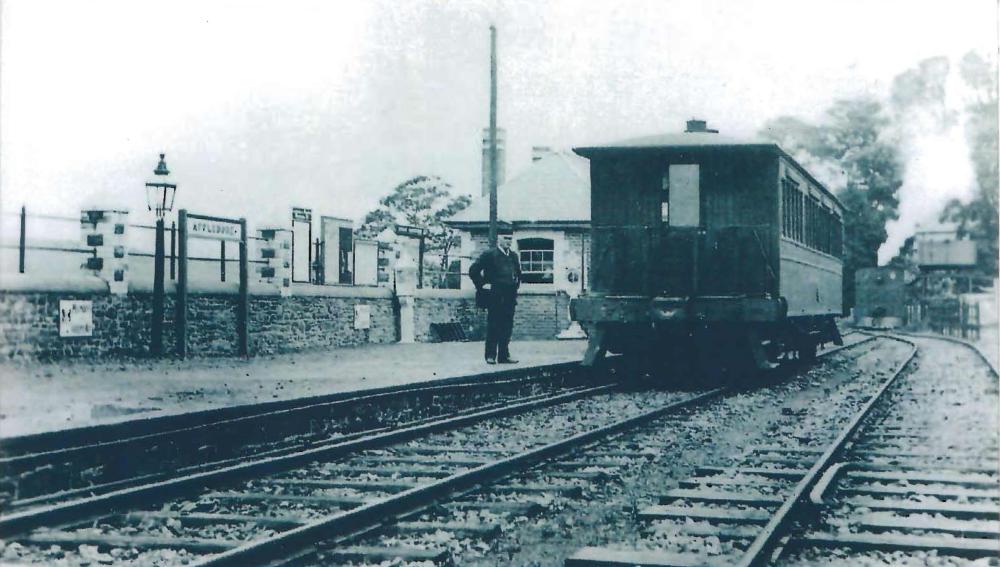
In 1902, a planning application was submitted for the provision of a refreshment room at the Westward Ho! train station.
The only fully staffed stopping places were Bideford, Westward Ho! and Appledore.
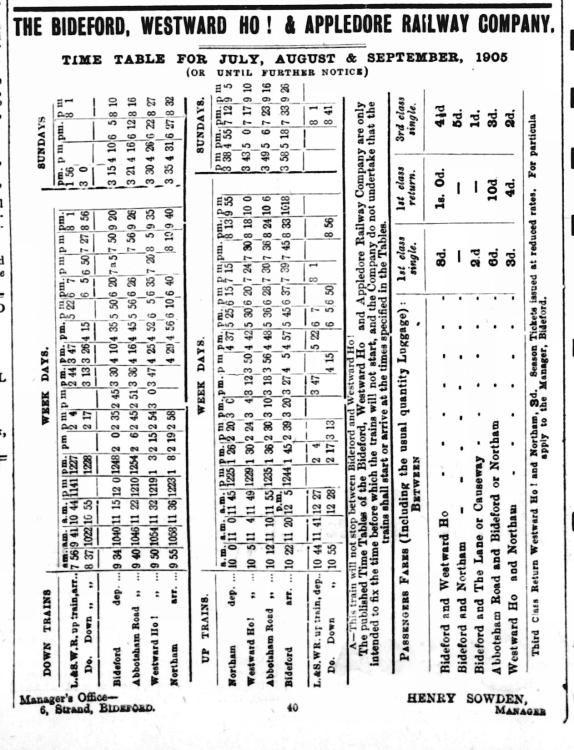
A 1905 timetable
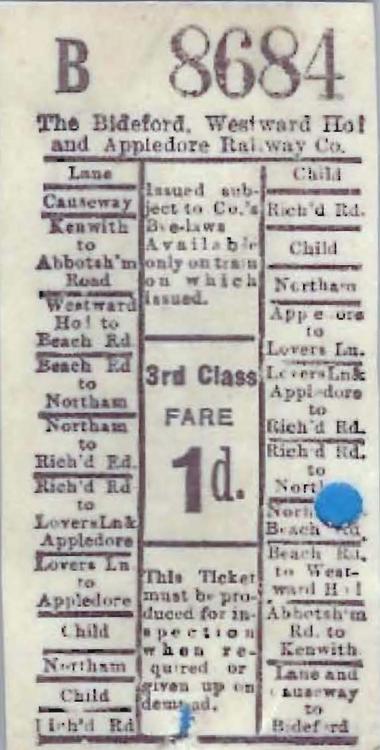
A third class fare was 1d
In 1908 the route was advertised as ‘comfortable’.
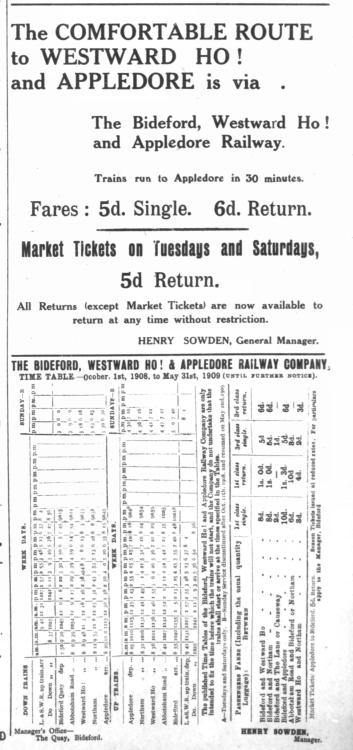
North Devon Gazette 1 December 1908
Employees
The Company employed about 21 staff, a number of which were gatemen at the level crossings.
In the 1911 Census, there are two men listed as ‘Station Master’ - John Loughlin, Camden House, Westward Ho! and Harold Moody, of Marine Parade, Appledore, who was directly attributed to working for BWH&AR.
William Stanbury, 5 Searle Terrace in Northam, was a railway clerk for L. & S.W railway; Harris; Mr Dicker – company workman; Henry Sowden – railway manager, 6 The Strand, Bideford; Frederick Palmer – Light railway fireman – 14 Willett Street, Bideford; Shephard; Hawkins – train driver; Mr Richard Harris – 4 Lamerton Place, Bideford - fireman and engineer; Alfie Curtis; F Bucker; Mr Spry – 6 Chingswell Street, Bideford - Westward Ho! signal box; Mr James Blackmore – 14 Glen Dale Terrace, Chanter’s Lane - carpenter; Frederick Fursey (Furzey) – gateman, Railway Cottage, Causeway; Jack Shears – Cross Street, Northam – railway platelayer (track man); Ned Kelly – Tower Street, Northam – railway ganger
Not all plain sailing
In 1902, “a special meeting of Bideford Town Council was held to consider a report from the Committee of the whole Council relative to certain important letters from the Bideford, Westward Ho! and Appledore Railway. The Mayor stated the object of the meeting and said the letters had been considered. Both letters were from Mr Stephen Sellon, who wrote from the offices of the British Electric Traction Company Ltd. He stated that the Railway Company had been called upon by the Board of Trade to adopt a different system of rail to that now in use on the Quay at Bideford. There had been many interviews in consequence of this decision of the Board of Trade, between the Company and that Department, and the Company now had pleasure in forwarding the Council a section of the rail which they proposed to adopt and which they had reason to assume would receive the sanction of the Board of Trade. The Company forwarded the section for the purpose of enabling the Council to send them any objection or criticism they might desire to make.”
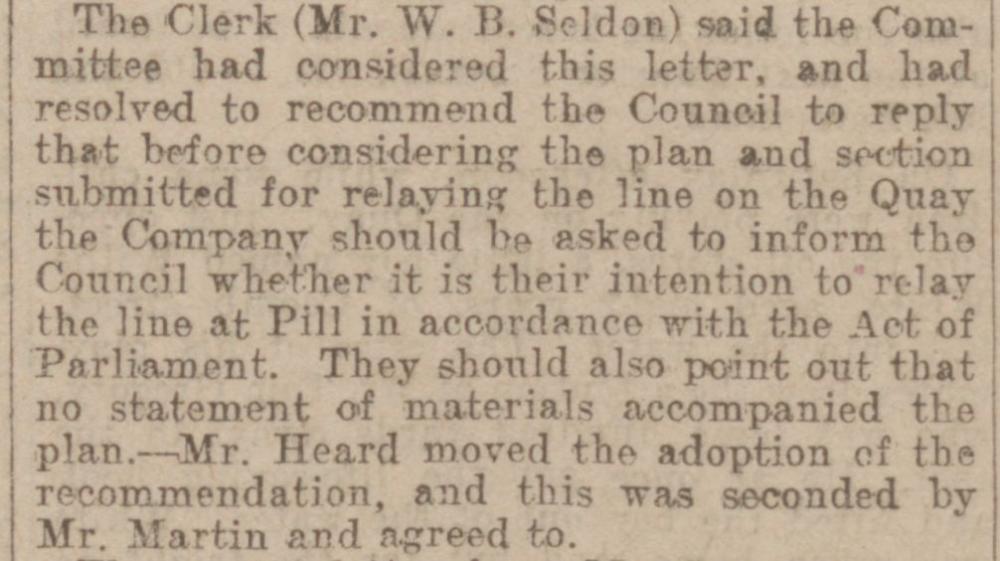
Western Times 7.7.1902
The second letter referred to the power given to the Company to make additional passing places, subject to certain conditions. “The Company now forwarded a plan showing a passing place which the Company proposed to construct at or near the commencement of Tramway or Railway No. 1 – opposite Mr Trewin’s stores – and the Company applied for the formal assent of the Council to the proposal. The Committee recommended the Council to reply that they could not give their consent.” The Council most strenuously objected to it.
In 1905, the British Electric Traction Company sued Mr Charles Chadwell, to recover about £8,000 due to them for completing the construction of the Bideford, Westward Ho! and Appledore Railway.
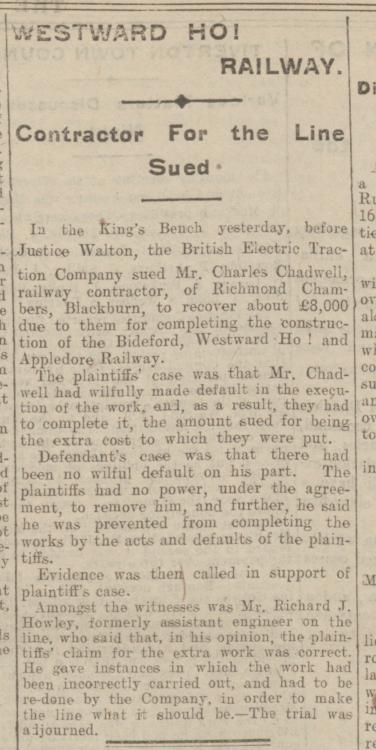
Western Times 11.7.1905
It was reported on August 21, 1907, in the Devon and Exeter Gazette, that a man “of Bideford, pleaded guilty to assaulting John Loughlin, stationmaster, at Westward Ho! on the Bideford and Westward Ho! Railway. Mr C E R Chanter who appeared for the Company said the directors felt they must protect their servants from such attacks. The complainant said that on Sunday, the 4th inst., about 7.20pm, three young men in an intoxicated condition arrived at the station and commenced playing. He went to warn them of their conduct when the defendant came up and struck him several blows in the face. Defendant was fined 17s inclusive.”
The end
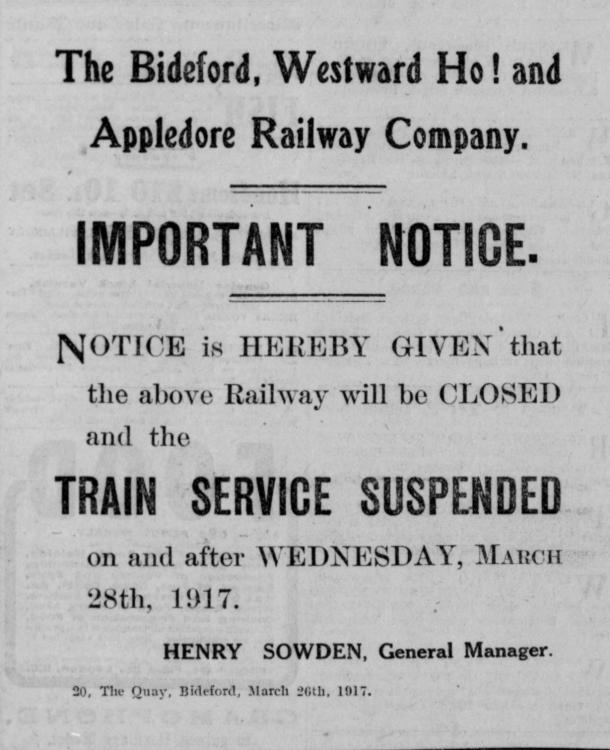
Bideford Gazette, April 3, 1917
It was reported in the Western Express, Torrington Chronicle (amalgamated with) Torrington Gazette and Weekly News, August 4, 1917 – “On Sunday several hundreds of residents assembled to witness the transference of the Bideford, Westward Ho! and Appledore railway engines “Kingsley,” “Torridge,” and “Grenville” across Bideford Bridge to East-the-Water, preparatory to their removal on the London and South Western railway to other spheres of usefulness. Temporary lines were laid across the bridge and the locomotives proceeded across under their own steam without mishap. The event was unique, even in the history of Bideford’s Long Bridge.”
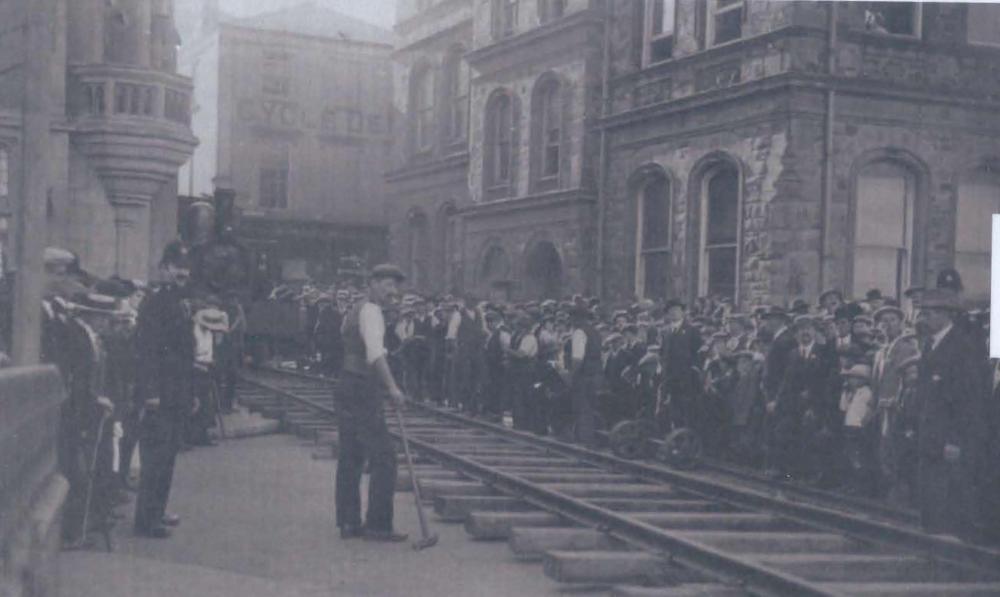
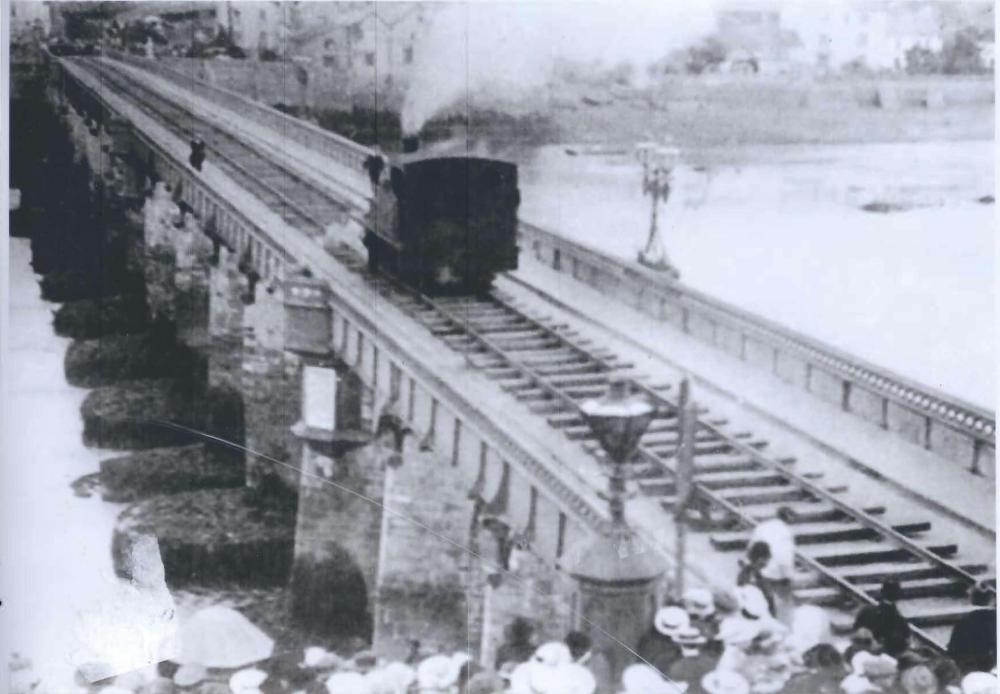
Was there a conspiracy and did the engines sink or see service near the front line?
Lieut-Colonel E V Thompson said that engines were loaded on to SS Gotterdammerung at Avonmouth, and were destroyed when the ship was torpedoed by a U-boat off the Cornish coast. Hunslet Engine Co. and others claim that the engines were despatched to Pembrey in South Wales for shipment to the front. Mr Sowden thought he saw one of the engines at Arras during the War. Mr Philip Kelly of Stanhope Terrace, Bideford, said he saw the engines, complete with identification, at Armentieres. Mr Eastman, of Clovelly, maintains that divers found a wreck, off the North Cornwall coast, 2 railway carriages 150ft beneath the Atlantic Ocean.
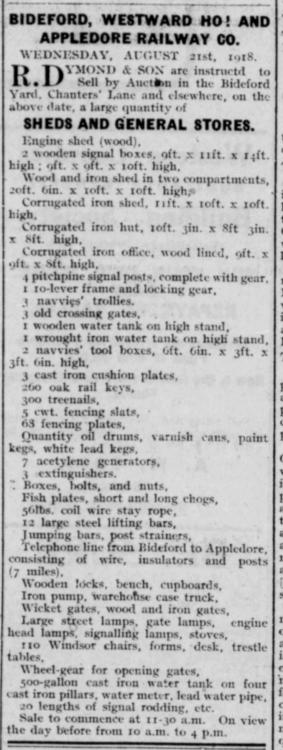
Other elements of the Railway were sold.
 f
f
North Devon Gazette 14 August 1918
In 1921, four of the railway coaches were sold at auction.
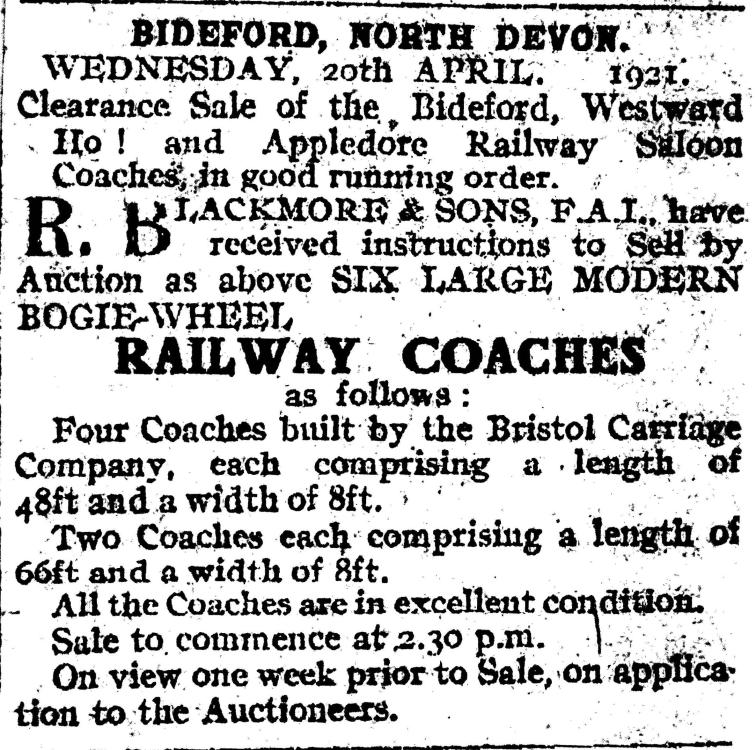
Whilst some of the coaches were sent to the Midlands, one of them was bought and conveyed to Westward Ho! for use as a beach hut.
Acknowledgements - Douglas Stuckey and his West Country Handbook No. 1; Wikipedia; Ordnance Survey; Stanley C Jenkins, MA, and his The Bideford, Westward Ho! & Appledore Railway